
Concrete Driveways, Walkways and Slabs in San Luis Obispo
Paso Robles Landscaping pours concrete for San Luis Obispo homes: driveways and garage aprons, front and side walks, patios and pool decks, equipment and shed pads, in broom, stamped, colored, sand or exposed-aggregate finishes. Inside city limits, the parts of a concrete job that cause trouble are rarely the slab itself. They are the strip between your property line and the curb, which the City treats as its own permit territory; the street trees and native oaks whose roots run under the pour; the creek setbacks that ban new paving along much of town; and the slope and runoff rules that decide where water goes. We plan around all of it before a form board goes down. Call 805-712-4440 or send a note through the contact form to book a site visit.
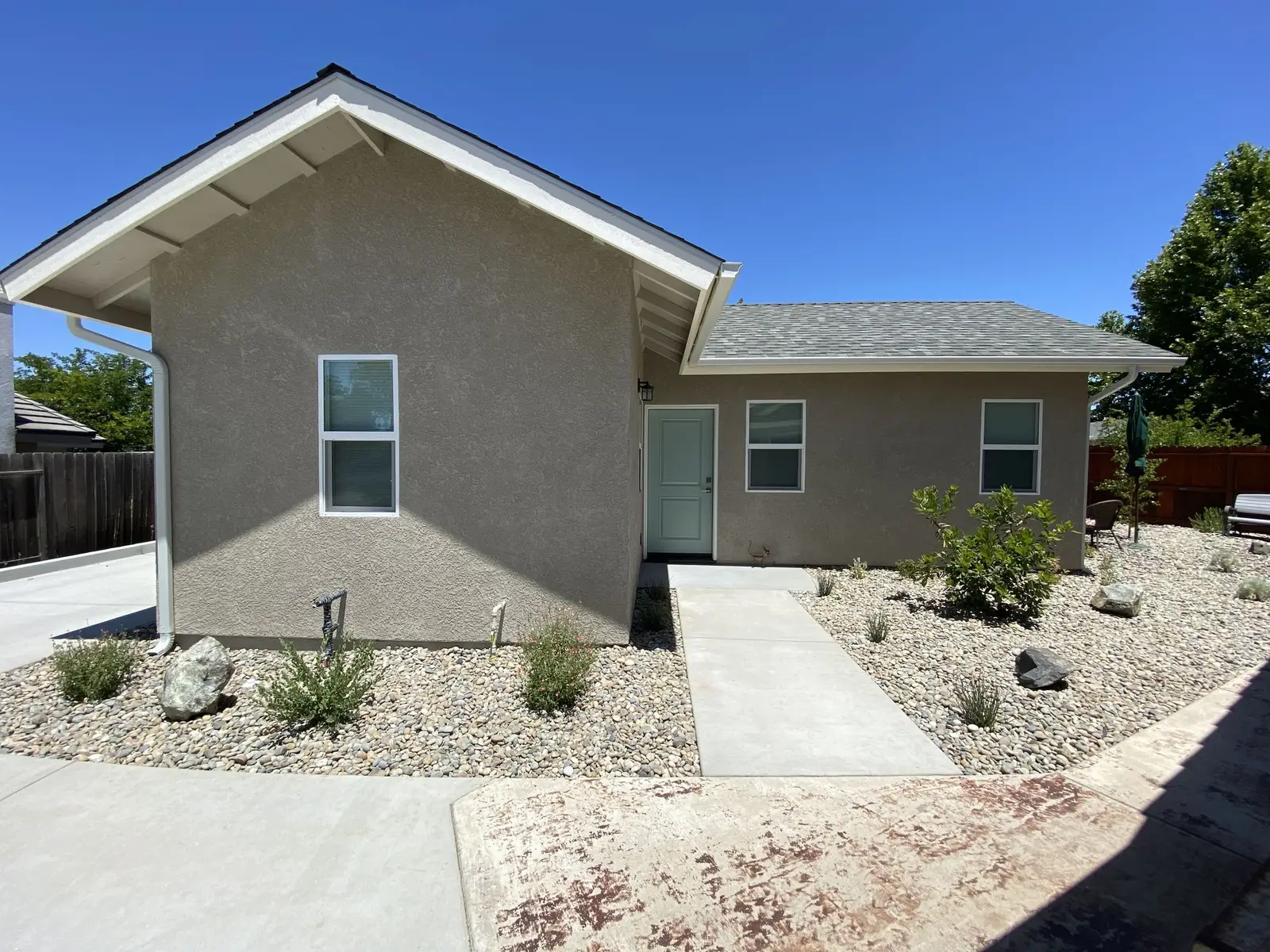
This page sticks to poured concrete. How much of a front yard may be paved, when a second parking pad is allowed and what the zoning setbacks are for yard features are covered on hardscape in San Luis Obispo. Pavers have their own page, paver installation in San Luis Obispo; covered and uncovered patios are on patios in San Luis Obispo; runoff and storm-drain rules are on yard drainage in San Luis Obispo; and walls that hold back soil are on retaining walls in San Luis Obispo.
San Luis Obispo Concrete Rules at a Glance
Each row below points to the City of San Luis Obispo page or Municipal Code section it came from. We read them on October 19, 2026; the City’s own sites block automated download tools, so open the links in a normal browser.
| Topic | What the City says | Where it comes from |
|---|---|---|
| The strip at the street | The City code defines the “sidewalk area” as everything between the property line and the curb line, including the parkway, the driveway approach, curbing and the sidewalk itself | Municipal Code 12.16.010 |
| Permit for that strip | Nobody may build, rebuild, repair, grade or remove any part of the sidewalk area without first getting an encroachment permit | Municipal Code 12.16.030 |
| Who does the work | A permit is required for all work in the public right-of-way, and curbs, gutters and sidewalks in City streets are to be built by a properly licensed and insured contractor | City sidewalk and parkway brochure (Rev 9/2025) |
| Construction standard | No sidewalk, curb, gutter or driveway may be broken out or built except to the City’s council-approved standard specifications | Municipal Code 12.16.040, Public Works documents |
| Driveway openings | A driveway matches the width of its curb opening, stays within Engineering Standard 2120 limits and sits entirely in front of the lot it serves unless the City and neighbor agree; unused driveway cuts must be removed when a new driveway permit is issued | Municipal Code 12.38.110 |
| Base under paving | City parking and driveway standards call for paved driveways and base compacted to at least 95 percent, with compaction reports to Community Development | Municipal Code 12.38.040 |
| Paving near trees | No concrete, asphalt, brick or gravel walk may be built near any tree in a way that cuts off air, light or water to the roots without written Public Works authority | Municipal Code 12.24.150(A)(4) |
| Creek setbacks | New paving is on the list of items barred from a creek setback; patios, pervious walkways and uncovered single-unit parking are exceptions, within limits | Municipal Code 17.70.030 |
| Grading | Small cuts and fills are exempt from a grading permit only under set size and slope limits; any work in a waterway needs a permit | Municipal Code 15.04.020 (Appendix J) |
| Work hours | Construction tools and equipment that disturb neighbors are prohibited on weekdays between 7 p.m. and 7 a.m. and all day on Sundays and holidays | Municipal Code 9.12.050(B)(6) |
Finishes We Pour in San Luis Obispo
Most SLO concrete jobs mix two or three of these, for example a broom-finish driveway with a colored border and a stamped entry court at the front door.
- Medium or coarse broom texture on driveways and garage aprons, pulled across the slope so tires and shoes bite when the marine layer leaves the surface damp
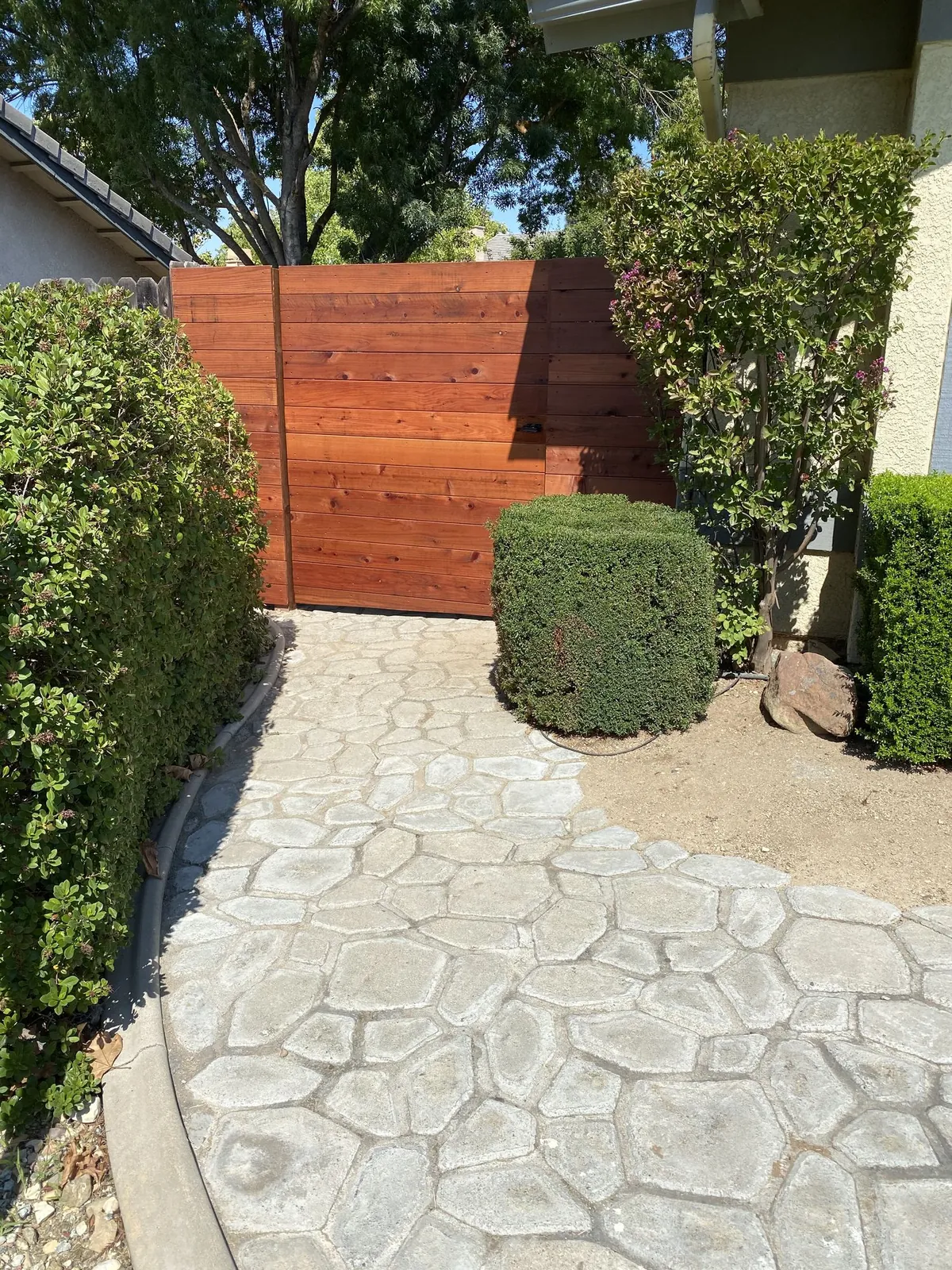
- Stamped slate, cobble or wood-plank patterns for entry courts and front walks, with integral color in the mix so a chip or scuff does not show gray underneath
- Integral or dry-shake color in earth tones that sit quietly next to stucco, brick and Craftsman siding in the older neighborhoods
- Exposed aggregate, washed back to reveal the stone, for sloped walks and pool surrounds where grip matters more than a smooth look
- Sand or light acid-etch finishes for a soft, even texture on patios and side walks that will stay uncovered
- Front, side-yard and garden walkways wide enough for trash bins, bikes and a wheelbarrow, with control joints laid out to the house lines
- Equipment pads, trash-enclosure floors, shed and greenhouse bases, and pads for EV chargers or a hot tub, set dead level or pitched as the use needs
- Two-track or ribbon drives and permeable bands that let rain soak in between the wheel paths, useful on long lots and near trees
Color and pattern choices matter more here than in many towns. Older streets near downtown, the Mill Street area and the neighborhoods around Cal Poly mix brick, stucco and wood-sided houses, and a muted tan or sandstone tone usually looks settled faster than bright red stamping. We bring sample boards to the site so you can see them against your house in the afternoon light.
Building the Private Side Right
A slab only lasts as long as what is under it. Much of San Luis Obispo sits on clay that swells in a wet winter and shrinks by August, so we dig out soft or organic soil, bring in base rock and compact it in lifts before any steel or concrete arrives. For driveways the City’s pavement standard sets a 95 percent compaction target for base material, and we hold residential drives to that figure whether or not a test is requested.
The City’s building code amendments are aimed at floor slabs inside buildings, but two pieces bear directly on yard concrete. First, the vapor-retarder requirement for slabs on the ground expressly exempts driveways, walks, patios and other flatwork that will not be enclosed later, so if you might wall in a patio someday, tell us now and we will plan that slab like a floor. Second, the City adds a rule that water from new improvements and changes in land contour may not be directed onto or across a neighbor’s property except through a recorded drainage easement or a natural waterway. That rule shapes how we pitch every driveway and side walk.
For grades, City parking standards in Municipal Code 12.38.060 keep parking spaces at no more than 5 percent slope in any direction and at least half a percent toward drainage, allow up to 10 percent in aisles and turnarounds, and require that any swale flatter than 1 percent be concrete. We use those numbers as the layout target for parking pads and turnarounds at houses, and we cut control joints at spacing that suits the slab thickness and shape so cracks fall where we want them.
Driveway Approaches, Curb Cuts and the Public Sidewalk
This is where SLO concrete projects most often stall. Under Municipal Code 12.16.010 a “driveway” in the City’s sense is the approach that crosses the curb, gutter and sidewalk area into your lot, and the sidewalk area runs from the property line to the curb line. Any construction, repair, grading or removal there requires an encroachment permit under Section 12.16.030, applied for through the Public Works director under Section 12.04.030 with plans, timing and the name of whoever is responsible for the work.
The City’s Encroachment Permits page says the City engineering division at 919 Palm Street handles these permits and that every application must include a Temporary Traffic Control Application and a complete traffic control plan; the City warns that the traffic control portion alone can take three to six weeks. A complete package also carries a commercial general liability endorsement and a Water Pollution Control Plan, and the permittee signs on as the job’s Water Pollution Control Manager. Regular inspections run Monday through Friday from 7 a.m. to 4 p.m.; night work needs its own permit, and downtown has an 11 a.m. to 1 p.m. quiet window for saw cutting and concrete demolition plus a holiday freeze on new sidewalk permits from Thanksgiving until after New Year’s Day.
Once a permit is issued, Section 12.16.030 requires it to be posted at the job, requires the forms to be inspected and approved before any concrete is placed (with at least four working hours’ notice), and voids the permit if work has not started within sixty days or is not finished within thirty days after that. The City’s sidewalk and parkway brochure adds that curb and gutter replacement is typically required when sidewalks and driveways are replaced, under Section 73 of the City’s Standard Specifications and Engineering Standards, which are posted on the Public Works documents page.
How we handle it: we build the private driveway, walk or apron up to the property line or the back of the public walk. The approach, curb cut, curb and gutter and any public sidewalk panels are a separate City permit item: they go through Public Works and are built by a contractor holding the license class and insurance the City requires for right-of-way work. We lay out our pour so it meets that work cleanly, share our grades with whoever holds the encroachment permit, and schedule around the City’s inspection so the two pieces line up.
Driveway layout rules from Municipal Code 12.38.110 come up early in that conversation: the driveway is the same width as its curb opening, inside the limits of Engineering Standard 2120; the ramp and transitions sit fully in front of your own lot unless the City and the neighbor sign off; the fire department may ask for more width; and as a condition of any new driveway permit, abandoned driveway cuts on the property have to be removed, landscaped and the curb, gutter and sidewalk restored. If you are moving a driveway, budget time for closing the old one.
Cracked or Lifted Sidewalk in Front of Your House
Many owners call us about a new driveway and discover the public walk out front is part of the job. The City’s brochure (revised September 2025) says the property owner is responsible for maintaining the sidewalk, parkway, curb and gutter along the frontage, citing Chapter 12.16 and state Streets and Highways Code procedures. It lists repair triggers: a vertical offset of three-quarters of an inch or more, gaps wider than half an inch, damage that pushes the slope steeper than 5:1, or any hazard the owner knows about.
Tree roots change who pays. Under Municipal Code 12.24.140, when a City street tree’s roots damage curbs, gutters, sidewalks or driveway ramps, the City is responsible for the fix; when the roots belong to any other tree, the owner is. The brochure notes the City schedules street-tree sidewalk repairs as funding and its area rotation allow, and that root pruning to prevent lifting must be done by a licensed arborist. If an owner installs or repairs a sidewalk, curb or approach, Section 12.24.140 asks them to look for options that keep healthy trees first.

Pouring Near Trees in San Luis Obispo
San Luis Obispo protects its urban forest closely, and concrete is one of the easiest ways to hurt a tree without touching the trunk. Section 12.24.150 forbids building a concrete, asphalt, brick or gravel walk, or filling the ground near any tree, in a way that shuts off air, light or water to its roots unless Public Works authorizes it in writing, and forbids storing building materials or equipment near a tree where they could injure it. The City’s parking and driveway standard also calls for porous paving, approved by the City Arborist, inside the dripline of existing trees near parking areas.
On our jobs that means we locate trees and their driplines before we draw the slab, keep trucks, base rock and washout well away from root zones, and switch to a ribbon drive, pavers on open-graded base or decomposed granite where a solid pour would cover too much root area. If a tree truly has to come out for the work, Section 12.24.090 sets the permit rules: removals tied to construction need an application, often an arborist report with the dripline drawn on the plan, and replacement planting at one new tree on site or two off site. Even small trees need a permit when they are within ten feet of the back of the sidewalk or in a creek setback. The City’s tree removal page asks owners to check with Urban Forestry first at trees@slocity.org or 805-781-7023.
Creek Setbacks and New Paving
San Luis Obispo Creek, Stenner Creek, Prefumo Creek and a network of smaller tributaries run behind a lot of homes. Under Municipal Code 17.70.030, creek setbacks are measured from the top of bank or the edge of streamside vegetation, whichever is farther from the water, and are 20 feet along creeks inside the 1996 city limits, with wider setbacks along some creeks in areas annexed later.
Paving and parking lots are on the list of things that cannot go in a creek setback. The code then carves out items that may be placed there without a discretionary exception, as long as they stay out of the channel, remove no native streamside plants, take no flood capacity and together cover no more than half the setback area: for a single-unit home, uncovered parking spaces; patios and pervious walkways; and low decks, stairs and landings. An impervious walkway in the setback needs a director’s hearing. So near a creek we steer clients toward permeable walks and keep any solid slab outside the line, and we confirm the top-of-bank location with the City before we design.
Grading, Runoff and Stormwater on a Concrete Job
A driveway or patio usually means some digging. The City’s grading rules in Section 15.04.020 exempt an excavation of no more than 50 cubic yards that is either under two feet deep or leaves no cut slope over five feet tall and steeper than one unit vertical to two horizontal, and a fill under a foot deep on gentle ground, or under three feet deep and not holding up a structure, up to 50 cubic yards per lot without blocking a drainage course. The same rules require a grading permit for any work in a waterway and say an exemption never authorizes work that breaks other codes. Where a grading plan is needed, it has to show every tree three inches or more in trunk diameter and a preservation plan for those that stay.
On stormwater, the City’s Post-Construction Requirements page says a Stormwater Control Plan is required for all projects to show either the level of compliance or an exemption, offers an online template, and lists permeable pavement among the control measures the City inspects. Most single driveways fall at the low end, but a large new hardscape area can move a project up, so we check the template early. Day to day, the City’s construction pollution guidance sets the habits on our pours: concrete trucks and pumpers never staged in the street, gutter or near a storm drain; plastic sheeting under the pump with perimeter controls around it; a lined washout for every cleanup; stockpiles kept on site and tarped before rain; and dry sweeping instead of hosing dirty pavement. For the drainage side of a yard, see yard drainage in San Luis Obispo.

Water Use Around New Concrete
Curing concrete needs moisture, and new beds around a drive need irrigation, but San Luis Obispo’s water conservation code treats water flowing off a property from excessive watering, or from a faulty system left unrepaired more than 72 hours after written City notice, as water waste runoff. We cure with sheeting or curing compound rather than long hose runs, aim drip and spray heads so the new surface stays dry, and set controllers so a fresh walk is not soaked every morning.
Noise and Work Hours
Municipal Code 9.12.050 prohibits running construction tools and equipment in a way that disturbs neighbors between 7 p.m. and 7 a.m. on weekdays and at any time on Sundays and holidays, and sets maximum noise levels for mobile equipment near single-family homes. We schedule early concrete deliveries and saw cutting inside those hours, and we let neighbors know when the pump truck is coming.
How a San Luis Obispo Concrete Job Runs
- Site visit. We measure, shoot grades, note trees and driplines, find the property line and the back of the public walk, and look for creek banks or drainage paths nearby.
- Layout and City check. We sketch the pour, mark anything in the sidewalk area as a separate City item, and confirm tree, creek, grading and stormwater questions with the right City desk.
- Coordination at the street. If an approach, curb cut or public sidewalk panel is involved, we coordinate grades and timing with the contractor who holds the Public Works encroachment permit.
- Base and forms. Soft soil comes out, base goes in and is compacted, forms and reinforcement are set, and pollution controls go up before the truck arrives.
- Pour and finish. We place, finish and joint the concrete in the texture and color you picked, then cure it properly.
- Cleanup and handoff. Washout is hauled, edges are backfilled and planted, and we walk the work with you.

City Contacts for a Concrete Project
- Encroachment permits (approaches, curb cuts, public sidewalk). City encroachment desk, 919 Palm Street, 805-781-7111, encroachment@slocity.org. Traffic control questions: traffic@slocity.org.
- Building and Safety. 805-781-7180; permits and inspections through the InfoSLO portal (permit forms page).
- Planning (zoning, creek setbacks). 805-781-7170.
- Public Works (street trees, sidewalk maintenance). 805-781-7220.
- Urban Forestry (tree removal). 805-781-7023, trees@slocity.org.
- Stormwater inspections. 805-781-7419.
Our California contractor license is CSLB #986950. Treat this page as a planning summary of City of San Luis Obispo documents, not legal or engineering advice; we are not City staff, civil engineers or certified arborists. Encroachment, tree, creek and grading decisions belong to the City, structural or grading design that needs a stamp comes from a licensed engineer, and work near protected trees follows an arborist’s terms. When a rule is unclear for your lot, we ask the City before we pour.
More San Luis Obispo Yard Guides
Other guides for San Luis Obispo yards and concrete work nearby:
- Hardscape in San Luis Obispo
- Patios in San Luis Obispo
- Paver installation, San Luis Obispo
- Yard drainage, San Luis Obispo
- Retaining walls, San Luis Obispo
- Backyard remodels, San Luis Obispo
- Outdoor kitchens, San Luis Obispo
- San Luis Obispo landscaping overview
- Concrete flatwork in Paso Robles
- Concrete flatwork in Atascadero
- Concrete flatwork in Templeton
- Concrete flatwork in Arroyo Grande
- Concrete flatwork in Morro Bay
- Concrete flatwork in Pismo Beach
- Concrete flatwork in Cambria
- Concrete flatwork in Grover Beach
- Concrete services
- Driveway paving
For every community we work in across the county, open the San Luis Obispo County service area page.
Frequently Asked Questions
Do I need a permit to pour a concrete driveway in San Luis Obispo?
For the part on your own lot, Building and Safety keeps a “Work Exempt from Building and Safety Permits” list on its permit forms page, and we confirm with that desk (805-781-7180) whether your flatwork needs a building permit; tree, creek, grading and stormwater rules can apply either way. The approach that crosses the curb, gutter and sidewalk area is different: Municipal Code 12.16.030 requires an encroachment permit for any work there, handled by the City encroachment desk at 805-781-7111.
Will you build the driveway approach and curb cut?
We build the private driveway up to the property line or the back of the public walk. The approach, curb cut, curb and gutter and any public sidewalk are a City permit item that goes through Public Works and is built by a contractor with the license class and insurance the City requires. We coordinate our grades and schedule with that work so the two meet cleanly.
Who pays to fix the sidewalk in front of my house in San Luis Obispo?
The City’s sidewalk brochure says the adjacent property owner maintains the sidewalk, parkway, curb and gutter. Under Municipal Code 12.24.140, if the damage comes from the roots of a City street tree, the City is responsible for the repair; damage from any other tree is the owner’s responsibility. Repairs in that strip still need an encroachment permit.
Can I pour concrete next to a creek in San Luis Obispo?
Usually not inside the creek setback. Municipal Code 17.70.030 lists paving among the things barred from a creek setback, which is 20 feet along creeks inside the 1996 city limits and wider along some creeks in later annexations. Patios, pervious walkways and uncovered parking for a single-unit home may be allowed within limits; an impervious walkway needs a director’s hearing.
Can concrete go under or near a tree in San Luis Obispo?
Only with care. Municipal Code 12.24.150 prohibits building a concrete, asphalt, brick or gravel walk or filling the ground near any tree in a way that cuts off air, light or water to its roots without written Public Works authority. We keep solid pours outside root zones and use ribbon drives, pavers or decomposed granite closer to trees, and check removal rules with Urban Forestry first.
Planning Concrete Work in San Luis Obispo?
Tell us about the driveway, walk or slab you have in mind. We will visit, measure, look at the trees, the slope and the street side, explain what the City needs, and send a free written estimate.
Call 805-712-4440 Get a Free Estimate
Paso Robles Landscaping · 1345 Riverside Ave, Paso Robles · Licensed contractor, CSLB #986950 · Serving all of San Luis Obispo County