
Yard Drainage in Nipomo
Nipomo yards have their own drainage habits. On the Mesa, rain tends to collect in low spots with nowhere to go, and many lots depend on a backyard retention basin to soak it in. Near Olde Towne, creeks and road ditches can back up in a hard storm. Our crews restore tired basins, pipe downspouts away from the house, build rain gardens and swales, and swap sealed paving for surfaces that let water in. Call 805-712-4440 or use the contact form, and we will walk the lot with you, ideally soon after a rain while the puddles and silt lines are still easy to read.
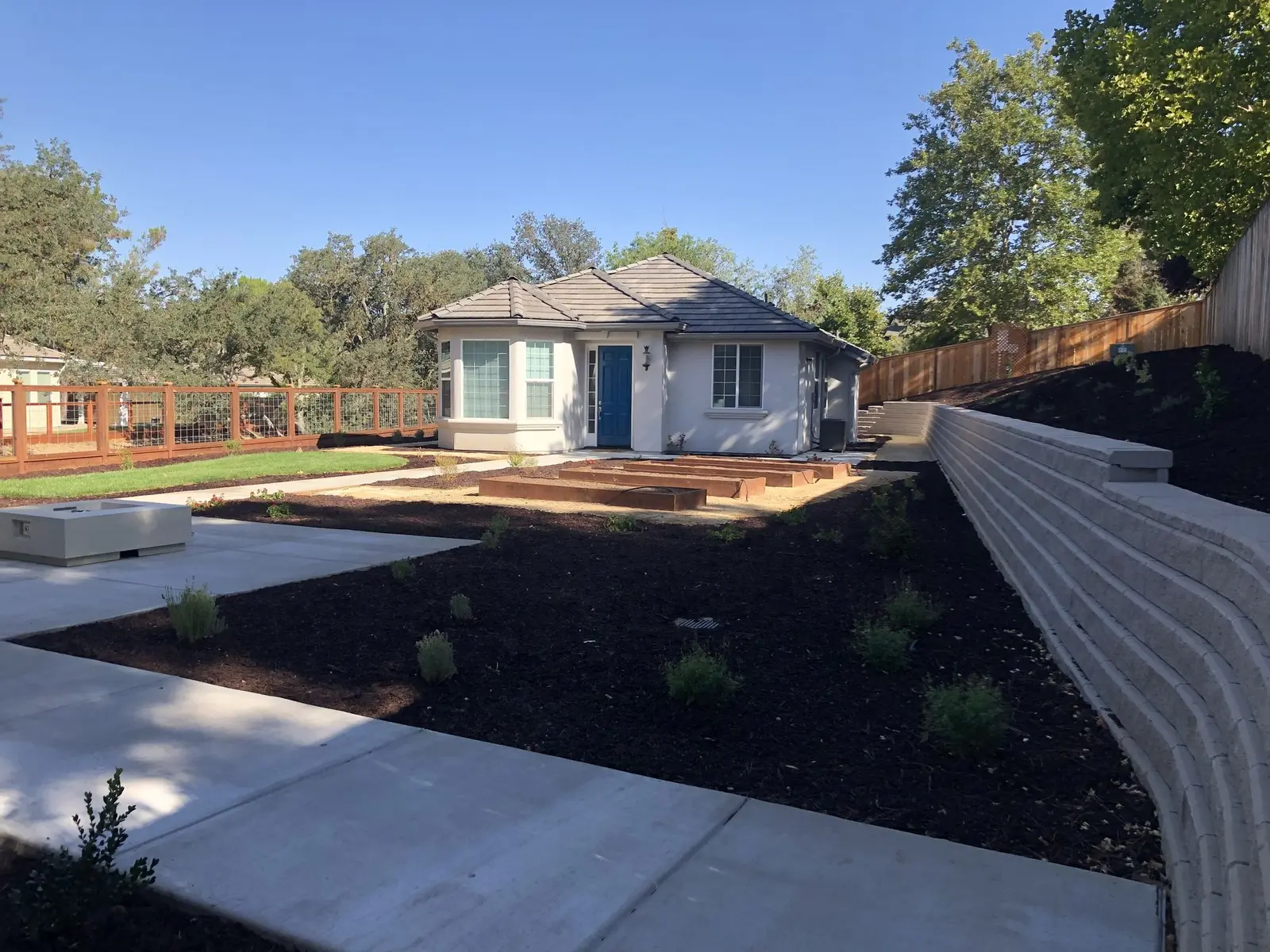
Nipomo Drainage Rules at a Glance
Nipomo is not a city, so there is no city hall to call about drainage. The County of San Luis Obispo handles grading, drainage and stormwater here, and the Nipomo Community Services District (NCSD) supplies water to much of the town.
| Topic | What the County or NCSD says | Checked Oct 16, 2026 |
|---|---|---|
| Who runs the storm drains | The County owns and operates the storm drain system in Nipomo, and Nipomo falls entirely under the County stormwater program | County stormwater program report |
| Drainage check on building permits | Public Works screens permits on slopes of 10 percent or more, in flood hazard areas, and in places with a flooding history, and the County names Nipomo as one of them | County drainage and flood hazard page |
| Grading permit | Earthwork over 50 cubic yards in total, over 20 cubic yards that alters or blocks a drainage way, or more than an acre of vegetation removal | County grading guidance quoting Section 22.52.060 |
| Stormwater design on one house | A single-family home that creates or replaces 2,500 sq ft or more of impervious surface must apply Performance Requirement 1 site design measures | County post-construction stormwater guidebook |
| Rain barrels | No permit for rainwater systems that hold up to 360 gallons for outdoor use | County rain barrel factsheet |
| Rain garden placement | At least 10 feet from building foundations and 50 feet from septic tanks and leach fields | County-hosted homeowner rainwater guide |
| Lawn conversion | The Cash for Grass Program serves owners in the Nipomo Mesa Water Conservation Area who replace irrigated turf with approved low-water plants | County Cash for Grass page |
Two Kinds of Drainage Trouble: the Mesa and Olde Towne
The County’s Nipomo Drainage and Flood Control Study (2004, one of several community studies on the County drainage studies page) splits the town into two very different problems.
On the Mesa, most complaints were about standing water. The study blames the rolling, undulating ground, which leaves many dips with no natural outlet, along with drainage features that were never maintained and development grading that cut off paths water used to follow. Because so much of the Mesa has no downhill escape, the drainage approach there was built around each parcel holding and infiltrating its own runoff. The catch, as the study points out, is that individual basins slowly lose capacity, so they overflow more often and send more water off the lot.
In Olde Towne, the issue is creek water. The study notes that much of Olde Towne sits in a FEMA 100-year flood hazard zone, that the worst flooding comes from flows breaking out of the creeks that run through town (Nipomo, Deleissigues and Haystack creeks among them), and that many culverts fall short of the current County standard. It also notes that most of those creeks cross private property and the County holds no drainage easement on them, so it cannot clear them outside the public right-of-way. Low lots near the channels can also flood in smaller storms when yard and street runoff has no good path to the creek.
Is Your Retention Basin Still Working?
If you live on the Mesa, there is a fair chance your lot has a retention basin: a dished area, sometimes lined with rock or planted, where roof and paving runoff is meant to collect and soak in. The study describes a County handout titled “Drainage Plan Required in Nipomo” and, at the time, basin sizing based on holding 4 inches of rain falling on the lot’s impervious area. Standards can change, so we confirm the current requirement with County Public Works before resizing anything. The study also states plainly that County drainage standards make onsite runoff the property owner’s responsibility.
Basins fail quietly. Watch for these clues:
- Fine silt or a crust on the basin floor that stays wet for days
- A basin that has been filled, leveled for a play area or planted solid
- New patios, sheds or a garage added without anyone enlarging the basin
- Overflow cutting a gully toward the fence line or the street
- Downspouts that were never connected to the basin in the first place
- Street or neighbor runoff entering the lot and filling the basin early in a storm
Our fix usually starts with digging out accumulated silt, loosening the floor so water can soak in again, and restoring the side slopes. We rebuild the spillway in rock so a big storm overflows in a controlled spot, reconnect every downspout, and plant the rim with species that handle wet feet and dry summers. If added hardscape means the basin is now undersized, we tell you before we build anything new.
What We Build on Nipomo Lots
Most projects mix a few of these. We start by tracing where the water comes from, where it collects now and where it can safely go.
- Cleaning out and reshaping an existing on-lot retention basin: removing silt, restoring its depth and rebuilding a stable spillway
- Solid drain lines from each downspout to the basin, a rain garden or a gravel infiltration trench, with cleanouts where lines turn
- Planted rain gardens sized to the roof or paving that feeds them
- Shallow grass or planted swales that move water across a gently sloped yard toward the basin instead of the street
- Rock-lined dry creek channels where a concentrated flow needs to slow down
- Permeable pavers, gravel or decomposed granite in place of new solid slabs
- Regrading side yards so the soil drops away from stucco, slab edges and crawlspace vents
- Channel drains at the bottom of a driveway that pitches toward the garage, tied to an on-site outlet
- Rain barrel hookups with screened lids and an overflow that empties into planting
- Mulch, erosion blanket and the County seed mix on bare banks before the first big storm
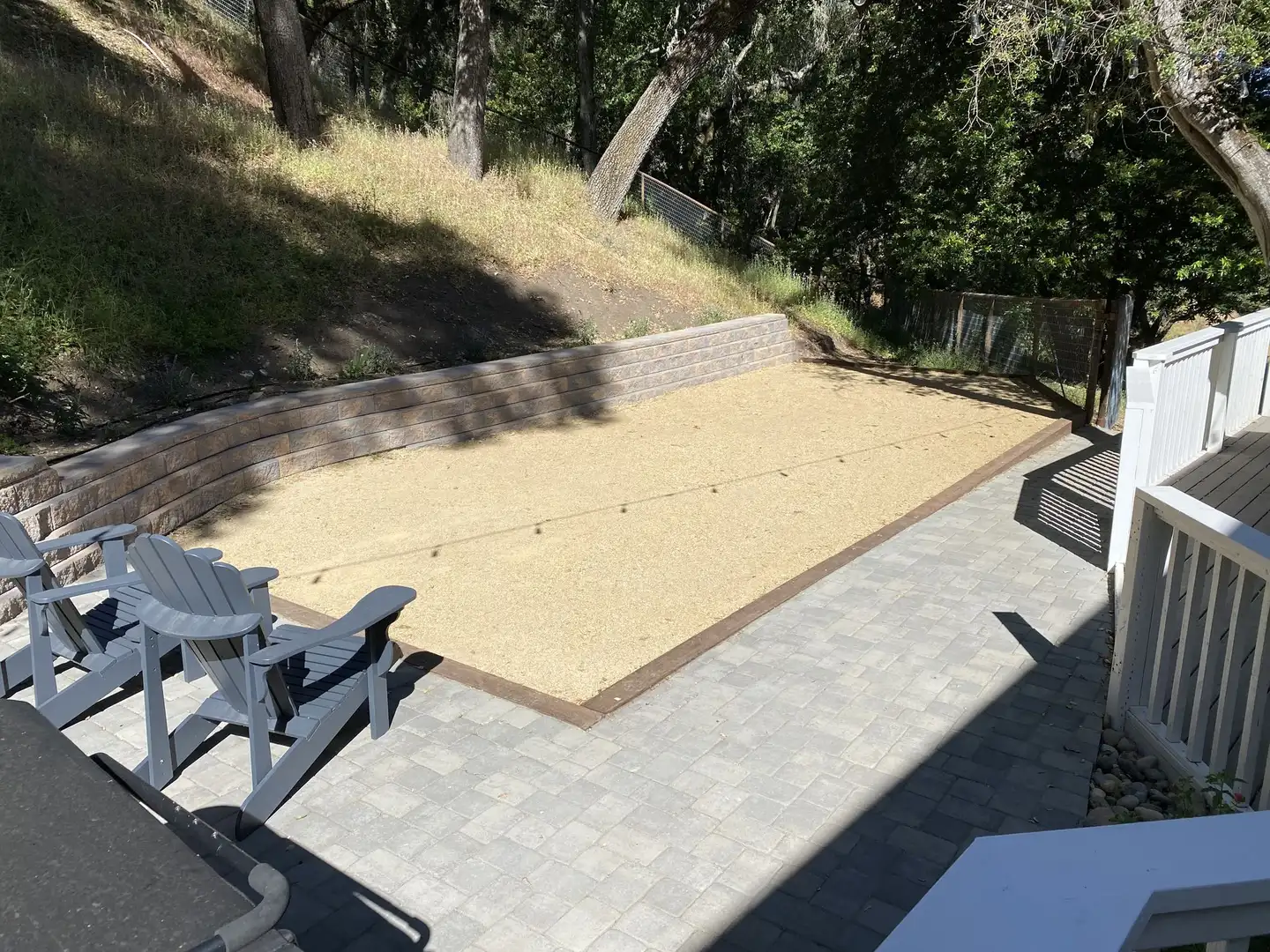
Test the Soil Before Choosing a Fix
Nipomo soils are not uniform. Some lots drain fast, others hold water near the surface. The Homeowner’s Guide to Rainwater Management posted by County Public Works lays out a simple percolation test: dig holes about 2 feet deep where a rain garden or trench might go, add a couple of inches of gravel, soak overnight, then measure how far the water drops every 30 minutes over several hours. In sandy ground where water falls faster than 6 inches in 25 minutes, readings are taken every 10 minutes instead. The guide reads the result like this:
| Rate (minutes per inch) | Typical soil | What the guide suggests |
|---|---|---|
| 0 to 4 | Very fast: coarse sand and gravel | Planted areas may benefit from added loam to hold moisture |
| 5 to 15 | Well draining: fine or loamy sands | Suitable for low impact development features |
| 16 to 60 | Slow: loams and clays | Amend with about one-third compost or add an underdrain |
| Over 60 | Very slow | Bring in a professional for the drainage design |
If skipping the test, the guide says to build the feature with an overflow path that carries water away from the house without causing erosion. We do that on every job anyway.
Rain Gardens and Swales Built to the County Guide
The same guide gives practical limits we follow on Nipomo projects:
- Keep rain gardens at least 10 feet from building foundations, off septic tanks, leach lines and shallow utilities, and call 811 before digging
- Size the garden so it drains within 72 hours; where soil soaks in slower than half an inch per hour (or one inch per hour for direct infiltration), add an underdrain
- Typical rain gardens run 4 to 8 inches deep and 100 to 300 square feet, and several small ones beat one large one
- Skip rain gardens on slopes of 15 percent or more, over high groundwater or on shallow bedrock
- Use vegetated swales on ground flatter than about 4 percent, with any ponding kept 10 feet from foundations and sidewalks
- Give every feature an overflow that leads away from the home and away from the neighbor
The guide lists benefits beyond a dry yard: lower water bills, water stored in the soil for plants, salts flushed out of the root zone, recharge of groundwater, less off-site flooding and less polluted runoff reaching the ocean.
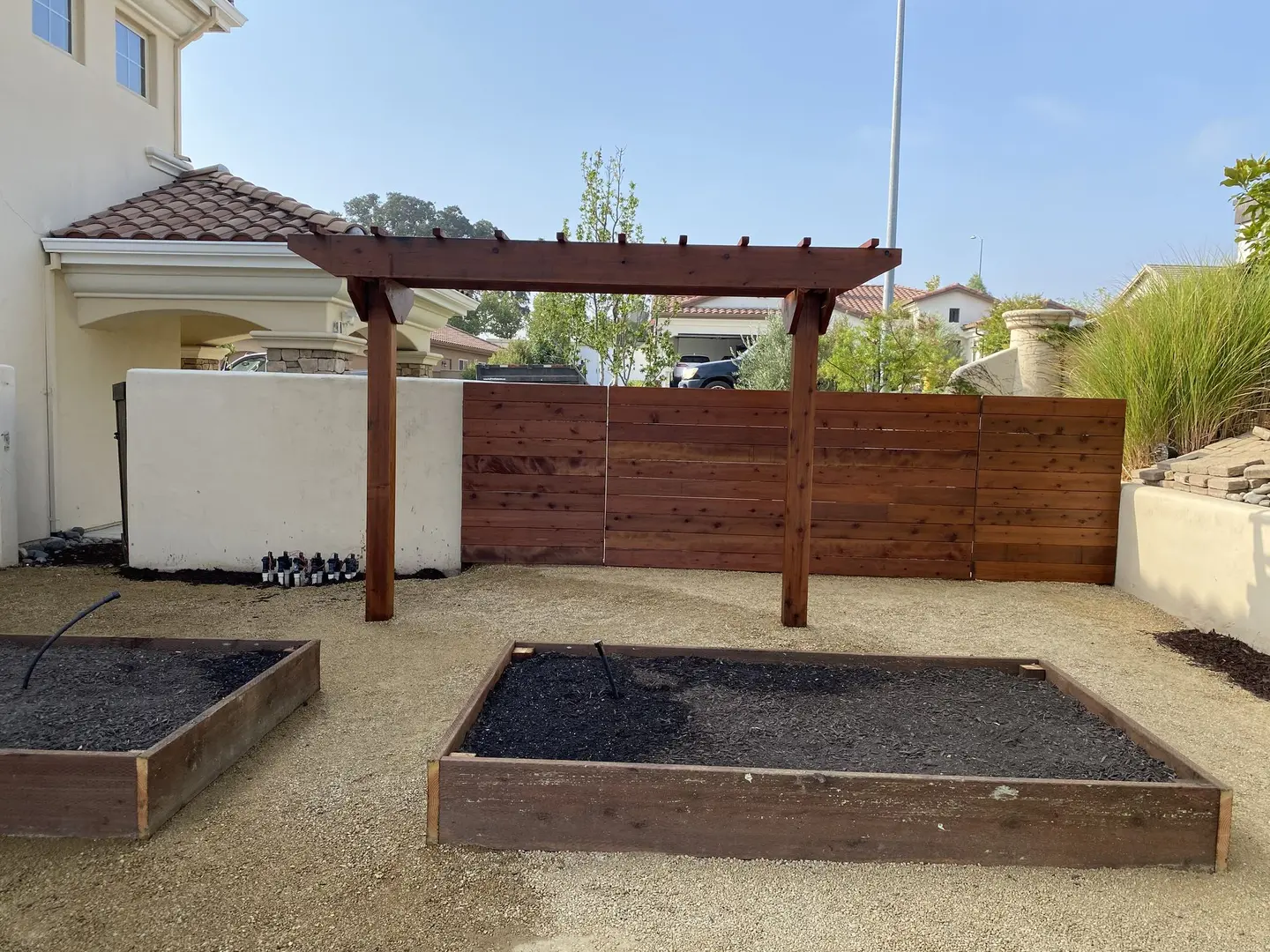
Rain Barrels Without a Permit
The County’s rain barrel factsheet says systems holding up to 360 gallons for outdoor use need no permit. It offers a quick way to estimate runoff: roof area in square feet, times rainfall in feet, times 7.48 gallons. A 250-square-foot roof section in a 2-inch storm sheds about 299 gallons, which is why we always plumb an overflow. The factsheet also calls for opaque barrels, screened openings to keep mosquitoes out, a debris screen, a height no more than twice the width, a secure anchor against tipping, a label warning that the water is not for drinking, and collecting from roofs only, never from driveways.
Driveways That Slope Toward the House
Some Nipomo homes sit below the road. The drainage study warns that without a proper curb or berm, a driveway that drops from the street toward the house can carry street runoff straight into the garage. It recommends that driveways slope down away from homes where feasible and that low driveways get a County standard mountable berm or an equivalent. On the private side of the property line we can add a channel drain across the driveway, reshape the landing, and route that water to the basin or a planted outlet. Anything at the edge of pavement or in the County road right-of-way is the County’s call, so we check with Public Works first.
Permits and Paperwork
- Grading. County Land Use Ordinance Section 22.52.060, as quoted in the County’s grading guidance document, treats excavation, cuts, fills, stockpiling, compaction and vegetation removal as grading (planting and tilling are not). A permit is needed when earthwork exceeds 50 cubic yards in total, exceeds 20 cubic yards and alters or blocks a drainage way or watercourse, or clears more than an acre. The County’s grading page adds that grading done without a required permit can mean an as-built permit, extra violation fees and engineer-directed digging to inspect the work.
- Drainage screening. When a project needs a building permit, Public Works may screen it for drainage and flood hazards, and the County lists Nipomo among the areas with a history of flooding.
- Stormwater design. Nipomo is inside the County’s state-permitted stormwater area. The post-construction guidebook puts a single home that creates or replaces 2,500 square feet or more of impervious surface in Tier 1, which means limiting disturbance of natural drainage features, limiting clearing and compaction, keeping hard surfaces to a minimum and adding at least one runoff reduction measure. The County’s requirements summary notes that local drainage and flood control rules apply on top of that, and a state construction permit applies once disturbance passes one acre.
- Flood zones. The drainage study summarizes the County flood standards in Section 22.07.060: no building in the floodway, and new homes with a finished floor at least one foot above the 100-year flood level. Yard work in a mapped flood zone gets checked with the County before we start.
County Public Works is at 805-781-5252 and Planning & Building at 805-781-5600. Paso Robles Landscaping holds CSLB #986950. We are landscape contractors, not civil or geotechnical engineers. Basin resizing for a new addition, work in a flood hazard zone, slopes that need stabilizing and anything that calls for a drainage report get an engineer’s design first, and we build to it. The County has the final say on every permit.
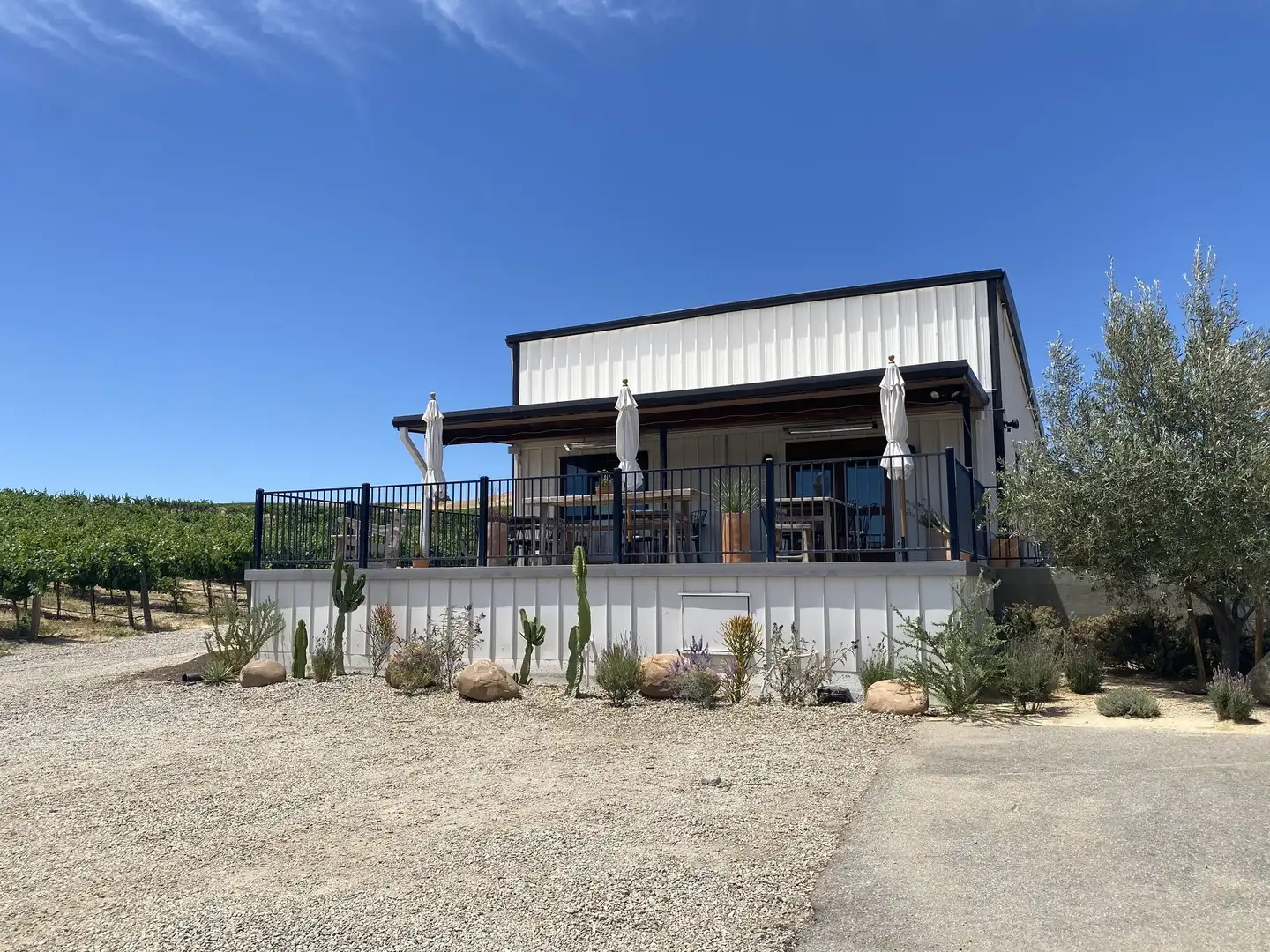
Cover Bare Soil Before the Storms
The County’s Stormwater at Your Home page explains that rain falling on roofs, driveways and patios runs off fast and picks up pollutants on the way to creeks and the ocean. Loose soil is one of the biggest of those pollutants on a landscape job. For bare ground, the County points to its standard seed mix, set in the 2019 Public Improvement Standards: California brome, small fescue, tomcat clover, sky lupine, California poppy and goldfields, chosen for low height and low fire risk. During our own jobs we cover soil and gravel piles before rain, sweep instead of hosing, keep mud off the street and leave exposed ground mulched or seeded.
Watering Smarter After the Rain
Drainage and irrigation are linked: an overwatered yard starts every storm already soaked. NCSD’s sustainable landscapes page says landscape irrigation makes up more than half of the average Nipomo household water bill, and its suggested watering schedule notes that summer demand in Nipomo rises by about 300 percent. The District’s conservation tips recommend seasonal controller changes and a simple sprinkler test to find out how much water each zone really puts down. We fix overspray onto driveways, convert beds to drip and turn controllers down for the wet season. For lawn swaps on the Mesa, the County Cash for Grass Program requires an approved plant list and an application before any turf comes out; our lawn replacement page covers the planning side.
More Guides for Nipomo Homeowners
Drainage work often leads into other parts of the yard. These pages pick up from here:
- Outdoor living spaces in Nipomo
- Water features in Nipomo
- Outdoor kitchens in Nipomo
- Landscaping in Blacklake, The Woodlands and Cypress Ridge
- Yard drainage in Arroyo Grande
- Yard drainage in San Luis Obispo
- Yard drainage in Pismo Beach
- Yard drainage in Avila Beach
- Yard drainage in Morro Bay
- Yard drainage in Cayucos
- Yard drainage in Grover Beach
- Yard drainage in Oceano
- Concrete driveways and walkways in Nipomo
- Retaining walls and terraces in Nipomo
- Patios in Nipomo and the retention basin
- Irrigation in Nipomo (watering stages and runoff)
- Landscaping in Nipomo
For the full list of towns we cover, start at our San Luis Obispo County service area page.
Frequently Asked Questions
My Nipomo backyard has a basin that floods every winter. What is wrong?
Usually it has lost capacity. The County drainage study for Nipomo notes that on-lot retention basins fill with silt or get altered over time and then overflow more often. Added patios also send more water to a basin that was sized for less. We clean it out, loosen the floor, rebuild the spillway and confirm current sizing with County Public Works.
Who do I call about drainage in Nipomo, the County or NCSD?
For grading, drainage and stormwater rules, the County of San Luis Obispo. The County owns and operates the storm drain system in Nipomo; Public Works is at 805-781-5252 and Planning & Building at 805-781-5600. NCSD is the water purveyor for much of town and handles water service and conservation programs.
Do I need a County permit to regrade my yard?
Not for most small jobs. Under County Land Use Ordinance Section 22.52.060, a grading permit is needed when earthwork exceeds 50 cubic yards in total, exceeds 20 cubic yards and alters or blocks a drainage way, or clears more than an acre. Planting and tilling are not counted as grading.
How far from the house should a rain garden go?
At least 10 feet from building foundations, according to the County-hosted homeowner rainwater guide, and well away from septic tanks and leach fields (the guide lists 50 feet). It should drain within 72 hours and have an overflow route that leads away from the house and the neighbor.
Can I add a rain barrel without a permit?
Yes, within limits. The County rain barrel factsheet says rainwater systems holding up to 360 gallons for outdoor use need no permit. Barrels should be opaque, screened against mosquitoes, anchored against tipping and fed from roofs only, with an overflow that empties into planting.
Water Standing in Your Nipomo Yard?
Show us where it collects and where it comes from. We will walk the lot, check the basin and downspouts, and give you a free written estimate.
Call 805-712-4440 Get a Free Estimate
Paso Robles Landscaping · 1345 Riverside Ave, Paso Robles · Licensed contractor, CSLB #986950 · Serving all of San Luis Obispo County
Related: pool decks in Nipomo.