
Yard Drainage in Pismo Beach
Pismo Beach sits on a narrow marine terrace squeezed between the ocean and the hills, so rain has a short, fast trip to the beach. On the terraces of Shell Beach the question is how to keep roof water off the bluff; in the hillside neighborhoods it is how to stop runoff from carving the slope; near Pismo Creek it is how to stay out of the streamside buffer. Our crews lead downspouts to planting, build gravel percolation galleries and rain gardens, replace sealed paving with surfaces that soak water in, and set outlets so nothing spills where the City does not allow it. Call 805-712-4440 or send the contact form, and we will come look while the stains and silt lines from the last storm are still visible.
Pismo Beach Drainage Rules in One Table
Pismo Beach is an incorporated city, so the City’s Public Works, Engineering and Building divisions set the rules for drainage on private lots inside city limits, including Shell Beach.
| Topic | What the City says | Checked Oct 16, 2026 |
|---|---|---|
| Stormwater Control Plan | Required for any project with 2,500 sq ft or more of new and replaced impervious surface | City Stormwater Management page |
| Construction erosion control | Projects disturbing under one acre use a Water Pollution Control Plan; over one acre needs a state SWPPP and Notice of Intent | City Stormwater Management page |
| Pipes across sidewalks | Drain lines and swales may not discharge onto a sidewalk; they must run under it to the gutter | Municipal Code 13.28.120 |
| Grading permit exemptions | Small cuts and fills are exempt only within set depth, slope and volume limits, and only if no drainage course is blocked | City Construction Codes & Amendments, J103.2 |
| Rainy-season grading on slopes | On slopes of 10 percent or more, grading is generally paused from November 1 to March 31 | Municipal Code 17.078.020 |
| Ocean bluffs | No drainage devices over the bluff face if the lot can drain away from it, and no new drains may spill onto the bluff | Municipal Code 17.078.060 |
| Pismo Creek buffer | Streamside protection zone of 25 to 100 feet depending on the bank and reach | General Plan/Local Coastal Plan, Policy CO-21 |
| Rain barrels and lawn removal | The City runs a Rain Barrel Rebate and a Cash for Grass program, both with City approval before any work starts | City incentive programs page |
Where the Water Goes in Pismo Beach
The City’s Conservation and Open Space Element describes a town built on a strip of marine terrace bordered by sandy beach and coastal bluffs on one side and steep hills on the other. Pismo Creek runs down Price Canyon and through town to a small lagoon at the beach, and Meadow Creek feeds Pismo Marsh at the edge of Grover Beach. Rain that leaves a yard enters the City storm drain system, and under Chapter 13.28 of the Municipal Code that system includes streets, gutters, inlets, pipes, channels and the creeks themselves. In practice, whatever runs off a driveway on a stormy morning reaches the ocean or the creek within minutes.
Three kinds of lots show up most often on our drainage calls here:
- Blufftop lots in Shell Beach and along the ocean. Water that pools near the bluff edge or spills over it speeds erosion of the cliff the house depends on.
- Hillside lots above town. Downspouts dumped onto a bank cut gullies, wash mulch into the street and leave silt fans across driveways.
- Flatter lots near the creek or the old marsh. Here the trouble is standing water against foundations and side yards that stay soggy for days after a storm.
What We Build on Pismo Beach Lots
Each job starts with where the water lands, where it wants to go, and where the City says it may go. Typical pieces:
- Pipe runs that carry downspout water across the yard to planting, a gravel gallery or a rain garden, and never toward a bluff edge
- Gravel percolation galleries and infiltration trenches sized to the roof area that feeds them, where the soil takes water
- Rain gardens and low planted basins with an overflow that heads somewhere safe
- Solid lines that pass beneath the public sidewalk to the gutter through a proper curb outlet, permitted through the City
- Regrading the strip beside the house so soil and paving fall away from walls, slab edges and crawlspace vents
- Permeable pavers, gravel or decomposed granite in place of new solid patios and side yards
- Rock splash pads and energy dissipators at the end of every outlet so water spreads out instead of cutting a channel
- Cobble swales and dry creek beds that slow a concentrated flow on a hillside lot
- Rain barrel stations on solid raised bases, strapped where tall, with lids and a hose bib for watering by hand
- Mulch, jute netting and quick planting on bare ground so a hard rain finds roots instead of loose soil
Downspouts, Sidewalks and the Street
Two sections of Chapter 13.28 matter for nearly every downspout in town. Section 13.28.100 lists uncontaminated roof drains, foundation and footing drains and French drains among the flows that are not treated as illegal discharges, as long as they are properly managed so no pollutants ride along. Section 13.28.120 then says no rainwater leader, pipe, conduit or swale may discharge water onto a sidewalk; lines that carry water off the lot must be led under the sidewalk to the gutter. The same section treats water sent into the street that grows a slick film in the gutter as a nuisance, which is a common result of an overwatered strip by the curb.
Before any water reaches the curb, though, we prefer to use it on site. The City’s Stormwater Control Plan application lists the runoff reduction choices that apply to regulated projects: roof water into rain barrels or cisterns, roof water into planted areas kept safely away from foundations and footings, patio and walkway runoff onto planting, driveway runoff onto planting, and permeable surfaces for driveways, walks and patios. Those are good habits on any lot, regulated or not.
A few more limits apply. Section 13.28.180 requires a City permit for any direct connection to the public storm drain system. Work in the street or a City easement needs an encroachment permit from the Engineering Division, requested by email at encroachments@pismobeach.org, with a bond that is released after final inspection. The City’s Applications & Permits page lists which contractor license classes may do which right-of-way work, for example C-27 landscaping contractors for landscaping work, C-8 for driveway approaches and sidewalks and C-12 for grading and paving.
The 2,500 Square Foot Line and the Stormwater Control Plan
The City’s Stormwater Management page explains that Pismo Beach runs its program under the state’s small municipal stormwater permit. A Stormwater Control Plan is required for projects with 2,500 square feet or more of new and replaced impervious surface. Below that, the application lets a project claim an exemption. For the design details, the application sends applicants to Chapter 3 of the San Luis Obispo County Low Impact Development Handbook, so on this point the City relies on the County handbook.
Performance Requirement 1 on the City checklist asks every regulated project to limit disturbance of creeks and natural drainage features, keep heavy equipment off the most permeable soils, clear and grade only what is needed, and cluster hard surfaces on the least sensitive part of the lot. Larger projects may also owe treatment, retention and peak flow control (Performance Requirements 2 through 4). For biofiltration beds, the checklist spells out the build: a planting mix of 60 to 70 percent sand with 30 to 40 percent compost (or a mix tested to soak in at least 5 inches per hour), a gravel layer at least 12 inches deep under the whole bed, an underdrain set at the top of that gravel, no compaction beneath the facility, and no liners unless sideways seepage is a real problem. The form also asks whether a registered civil engineer prepared the plan.
Under Section 13.28.160, owners of projects that install permanent stormwater devices submit a maintenance plan, sign a recorded agreement with the City and send yearly inspection reports. If your lot already has one of those devices, we can clean and restore it to the plan on file.
Shell Beach and Other Blufftop Lots
Section 17.078.050 of the Municipal Code sets new structures back far enough from the bluff edge to stay safe from erosion for at least a century. On single-family lots created before January 23, 1981, the minimum is 25 feet from the top of the bluff, and the City Engineer may ask for a geologic investigation and a larger setback. Other blufftop development needs a geologic study, and a site-specific erosion control plan prepared by a registered engineer with hydrology and soil mechanics experience.
For drainage, Section 17.078.060 is direct. Drainage devices extending over the bluff face are not permitted if the property can be drained away from the bluff, and all new drainage structures must be built so water does not spill over or onto the bluff face. Drainpipes on the bluff face are allowed only where no less damaging system is feasible. Our approach on these lots is to turn the whole yard around: grade toward the street side, collect roof water in solid pipe, hold some of it in barrels or planting, and send the rest to an approved street-side outlet. We keep irrigation light near the edge, because Section 17.078.050 lists irrigation water and altered surface drainage among the conditions a geologic report must consider.
Hillside Lots: Runoff Plans and the Winter Grading Pause
For development in areas of the city with slopes of 10 percent or more, Section 17.078.020 of the Municipal Code asks for a runoff control plan designed by a licensed engineer qualified in hydrology and soil mechanics before a building permit is issued. The code favors minimal grading, erosion-resistant planting and structural pieces such as on-site percolation galleries, and it requires energy dissipating devices at the end of outflow drains. Permanent erosion control is installed before or along with grading, and disturbed ground is planted before November 1 with enough seed, mulch and water to reach 90 percent cover within 90 days, using native species wherever feasible.
The same section bars grading for roads, building pads, utilities and erosion control devices from November 1 through March 31, with narrow exceptions: slopes that do not drain to an environmentally sensitive habitat, small jobs of 50 cubic yards or less on ground flatter than 10 percent, and, outside the coastal zone only, work under an erosion control plan agreed to in writing by state wildlife officials and the City Engineer. Grading on slopes steeper than 30 percent is prohibited, and the City’s hillside rules cap it at 20 percent in the coastal zone portion of Pismo Heights. Runoff from projects that drain to Pismo Creek or to the marsh in the Meadow Creek watershed may not exceed the rate, volume or sediment load of the land in its natural state.
Lots Near Pismo Creek and Pismo Marsh
Policy CO-21 of the City’s General Plan/Local Coastal Plan keeps Pismo Creek in its natural state with a streamside protection zone, measured from the outer edge of riparian vegetation or, where there is none, from the top of the creek bank:
- West bank: 100 feet from Cypress Street north to the city limits, and 25 feet from Cypress Street to the ocean
- East bank: 100 feet north of U.S. 101, 50 feet from U.S. 101 to Dolliver Street, and 25 feet from Dolliver Street to the ocean
Inside that buffer, no new construction or vegetation removal is allowed beyond normal maintenance, apart from a short list of items such as paths, fences and flood control structures, and concrete channeling of the creek is not permitted unless no viable alternative exists. Policy CO-23 sets a 100-foot buffer around Pismo Marsh, and Policy CO-14 calls for a riparian buffer generally not less than 25 feet along smaller riparian areas. The zoning code’s Section 17.22.020 applies these riparian setbacks to structures, paving and grading. Chapter 13.28 adds that an owner whose property a watercourse passes through must keep that stretch free of trash and debris and may not strip healthy bank vegetation beyond what maintenance requires. On creekside lots we keep new patios, paths and drain outlets outside the buffer and check the exact line with the City before any digging.
Permits and Paperwork
- Grading. The City’s Construction Codes & Amendments booklet (the edition effective January 1, 2023 was the one posted when we checked; confirm current wording with the Building Division) exempts excavation of 50 cubic yards or less that is under 2 feet deep or leaves no cut slope taller than 5 feet and steeper than 1 to 2, fill under 1 foot deep on ground flatter than 1 to 5 that supports no structure and blocks no drainage course, and fill under 3 feet deep that stays under 50 cubic yards on the same terms. A grading plan, when one is needed, has to show existing drainage conditions and devices and every proposed change, and locate trees 3 inches or more in diameter.
- Exempt still has rules. The City’s permit exemptions handout reminds owners that work exempt from a building permit is still subject to Planning, Engineering and Fire requirements. Garden walls up to 4 feet from the bottom of the footing, with no surcharge, and new walks and driveways are on the building permit exemption list, but drainage, setback and stormwater rules still apply.
- New homes and additions. The building submittal checklist calls for a grading, drainage and utility plan, a landscape plan, a soils report for projects of 500 square feet or more, and a drainage report; ask the Building Division for the City’s Drainage Requirements handout.
- Erosion control standards. The booklet points erosion control to the City stormwater program, the Regional Water Quality Control Board’s Erosion and Sediment Control Field Manual, state stormwater permits and the California Green Building Standards Code.
Useful City numbers: Public Works and Engineering 805-773-4656, Building Division 805-773-7040, Stormwater Hotline 805-773-7055. Paso Robles Landscaping holds CSLB #986950. We are landscape contractors, not civil or geotechnical engineers. Blufftop drainage, runoff control plans on slopes of 10 percent or more, work near Pismo Creek or the marsh, and anything that calls for a drainage report or Stormwater Control Plan get an engineer’s design first, and we build to it. The City has the final say on every permit.
Keeping Soil and Water on the Job Site
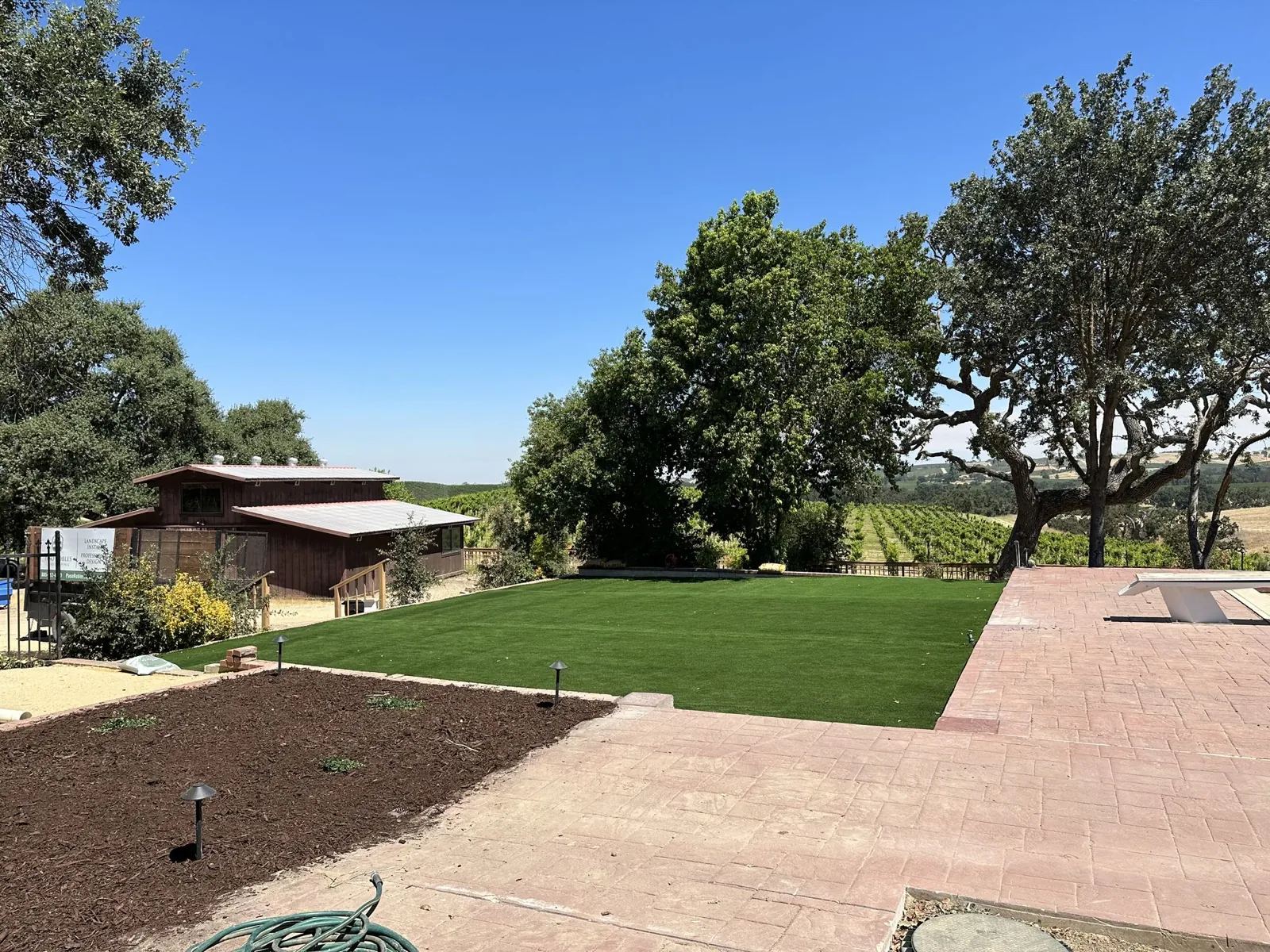
Section 13.28.150 asks anyone holding a grading permit, or another permit likely to create a pollution source, to submit an erosion control plan, and lets the City stop work if the protection on site fails. On our jobs that means covering soil and gravel piles before rain, keeping a clean exit so trucks do not track mud onto the street, protecting nearby inlets, washing tools where the rinse water stays on site, and leaving bare ground mulched or planted at the end of each phase.
Irrigation and Water Rules That Affect Drainage
A yard that is already soaked when the storm arrives sheds more water. Pismo Beach is under a Normal Water Supply condition, and the City water conservation page and Section 13.24.030 of the Municipal Code list what that means: no water use that runs off onto neighbors, walks, streets, gutters or structures; no hosing driveways, patios or sidewalks; no outdoor irrigation from 10 a.m. to 4 p.m.; no irrigation during measurable rain or for 48 hours after it; and fountains must recirculate. If the City Council declares a moderately restricted condition, watering drops to two assigned days a week by address and drinking water may not be used for compaction or dust control on construction sites. The City also adopted an urgency ordinance that prohibits installing new irrigated turf for all development as of May 18, 2022.
The City’s water conservation tips fit drainage work well: short, frequent cycles on sandy soil, deeper and less frequent watering on clay, a broom instead of a hose, and regular checks for broken heads that run unnoticed at night. City staff also offer a home water audit that checks outdoor plumbing (805-773-7054). We repair overspray onto paving, convert beds to drip and turn controllers down for the wet months.
City Rain Barrel and Lawn Programs
The City’s Water Conservation Incentive Programs include a Cash for Grass Rebate Program, a Rain Barrel Rebate and a Smart Irrigation Controller Rebate, each subject to funding. The rain barrel terms call for at least two and no more than four store-bought barrels of 50 gallons or more on a City water account, set on a solid base at least 6 inches high, strapped to the house when the barrel is more than twice as tall as it is wide, lidded, kept clear of walkways, and used by hose or bucket rather than tied into the irrigation system; approval comes first and an inspection follows installation. The Cash for Grass terms require drip or micro-spray irrigation on an automatic timer, and conversions started without City approval are ineligible. Questions go to WaterRebates@pismobeach.org or 805-773-4656. Our lawn replacement page covers planning a turf swap.
Related Guides for Pismo Beach and Shell Beach
Drainage tends to lead into the rest of the yard. These pages pick up the thread:
- Landscape design in Pismo Beach
- Landscaping in Shell Beach
- Outdoor living spaces in Shell Beach
- Retaining walls
- Yard drainage in Arroyo Grande
- Yard drainage in Nipomo
- Yard drainage in San Luis Obispo
- Yard drainage in Avila Beach
- Concrete driveways, walks and patio slabs in Pismo Beach
- Retaining walls and terraces in Pismo Beach
- Patios in Pismo Beach
- Irrigation and watering rules in Pismo Beach
- Yard drainage in Morro Bay
- Yard drainage in Cayucos
- Yard drainage in Grover Beach
- Yard drainage in Oceano
- Concrete driveways, walks and patio slabs in Grover Beach
To see every community we work in, visit our San Luis Obispo County service area page.
Frequently Asked Questions
Can my downspouts drain to the street in Pismo Beach?
Clean roof water is allowed in the storm drain system under Municipal Code Section 13.28.100, but Section 13.28.120 says no pipe or swale may discharge onto a sidewalk; the line has to pass under the sidewalk to the gutter. A direct tie into a City storm drain needs a City permit, and curb work in the right-of-way needs an encroachment permit. Sending roof water to planting or a gravel gallery first is usually the simpler fix.
Do I need a grading permit to regrade my Pismo Beach yard?
Often not for small work. The City’s grading exemptions cover excavation of 50 cubic yards or less that is under 2 feet deep or leaves no cut slope over 5 feet tall and steeper than 1 to 2, and shallow fills on gentle ground that do not block a drainage course. Slopes of 10 percent or more add rules, including a general pause on grading from November 1 to March 31.
Where should drainage go on a Shell Beach blufftop lot?
Away from the bluff. Municipal Code Section 17.078.060 does not permit drainage devices over the bluff face if the lot can drain away from it, and new drains may not spill onto the bluff. We grade and pipe toward the street side and keep irrigation light near the edge, following an engineer’s erosion control plan where one is required.
How close to Pismo Creek can I build a patio or path?
It depends on the bank and the reach. Policy CO-21 of the General Plan/Local Coastal Plan sets a streamside protection zone of 100, 50 or 25 feet measured from the outer edge of riparian vegetation or the top of bank, and the zoning code applies riparian setbacks to structures, paving and grading. Paths and fences are among the few listed exceptions, so confirm your line with the City first.
Does the City of Pismo Beach help with rain barrels or lawn removal?
Yes. The City offers a Rain Barrel Rebate and a Cash for Grass Rebate Program for City water customers, subject to funding. Both require City approval before work begins and an inspection afterward. Barrels must be at least 50 gallons, two to four per property, raised on a solid base and lidded; new landscaping under Cash for Grass needs drip or micro-spray on a timer.
Rain Running the Wrong Way in Your Pismo Beach Yard?
Show us where it pools, where it spills and where it leaves the lot. We will walk the property, trace the downspouts and give you a free written estimate.
Call 805-712-4440 Get a Free Estimate
Paso Robles Landscaping · 1345 Riverside Ave, Paso Robles · Licensed contractor, CSLB #986950 · Serving all of San Luis Obispo County