
Yard Drainage in Paso Robles
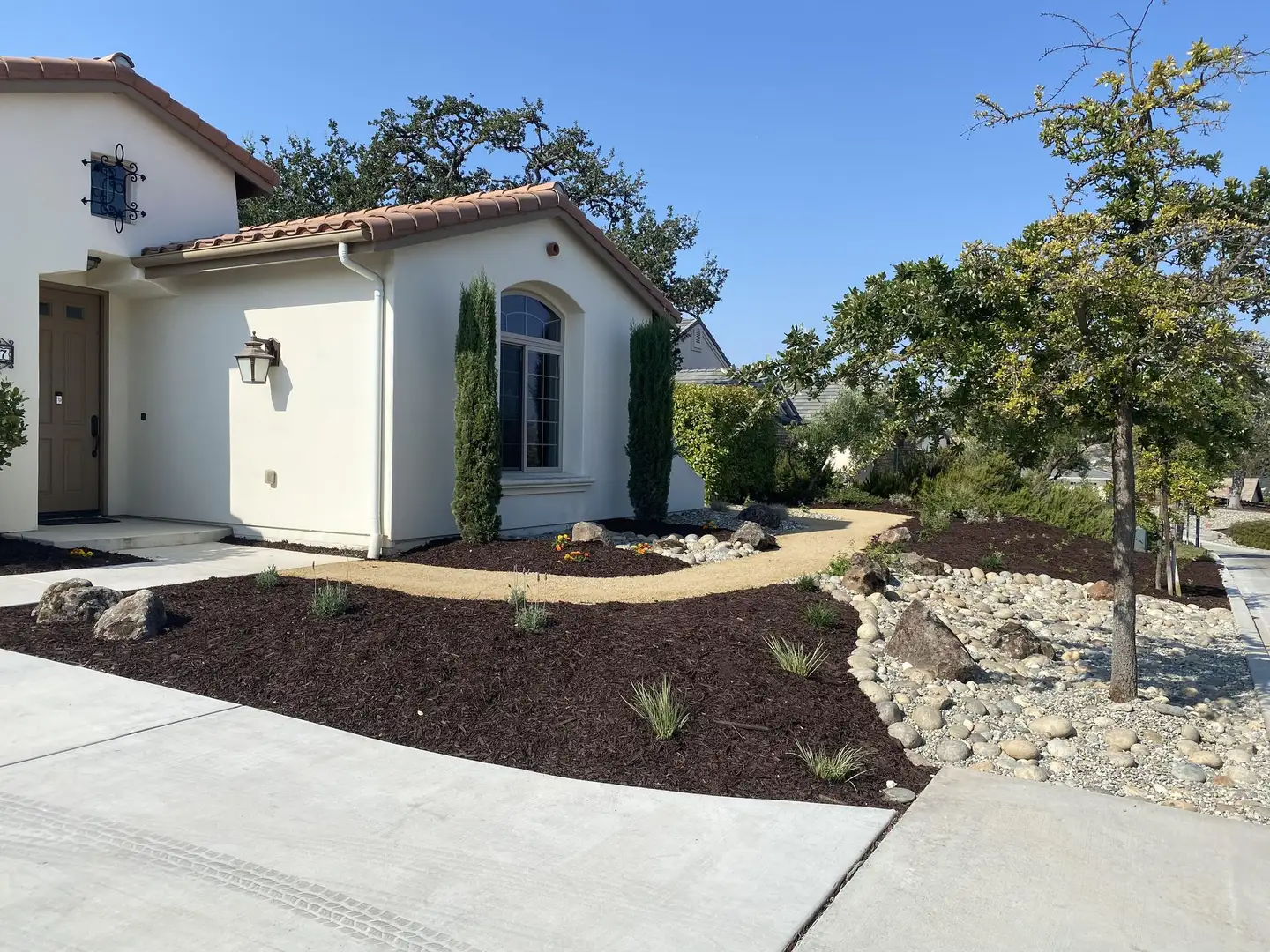
Paso Robles Landscaping fixes yard drainage for homes in Paso Robles: regrading so water runs away from the house, downspouts piped out to planting beds, river-rock swales, permeable pavers, area drains and retaining walls with proper drain rock. The first real storms of the season are when soggy side yards, washed-out beds and water against the foundation show up, and they are easier to fix before the ground stays wet. We plan the work around the City of Paso Robles' own stormwater guidance, which favors keeping rain on the property and soaking it into landscaping instead of sending it to the street. Call 805-712-4440 or use our contact page to set up a visit.
Paso Robles Drainage Rules at a Glance
| Topic | What the City says | Source (checked Oct 11, 2026) |
|---|---|---|
| Roof and paving runoff | Direct it to vegetated areas; impervious area draining to a bed no more than twice that bed's size | Stormwater Control Plan, single-family form |
| Area drains in planting | Inlets at least 3 inches above the surrounding grade | Stormwater Control Plan, single-family form |
| Stormwater plan trigger | Single-family projects that create or replace 2,500 sq ft or more of impervious surface | Post-construction stormwater page |
| Grading | A City permit unless the work fits an exemption in Municipal Code 20.04.040 | Grading permits page |
| Rain barrel overflow | Directed away from foundations (the guide suggests a hose to at least 6 feet out) and never onto a neighbor's lot | City rain barrel guide |
| Sprinkler runoff | Watering that causes excessive flow or runoff is prohibited | Watering restrictions |
Why Yards Hold Water
Most drainage calls trace back to a few things we see again and again: beds built up higher than the slab, downspouts that dump right at the corner of the house, a patio poured flat or tipped toward the wall, a side yard with nowhere for water to go, or a slope above the house with no swale to catch what comes down it. Sprinklers make it worse when they run onto the same low spot all year. None of these fix themselves, and each one is usually a matter of grade, outlets and a path for the water.
We start by walking the lot, ideally during or right after rain, and marking where water lands, where it collects and where it leaves the property. That map drives everything else, so the fix matches the problem instead of adding a drain where it is not needed.
Send Roof Water Into Planting, Not the Gutter
The City's Stormwater Control Plan form for single-family site plans lays out a simple approach that also happens to be good drainage practice. Downspouts can be pointed at planted areas beside the house or extended by pipe to beds farther away. Paved areas can be built without curbs, or with curb cuts, so water flows into the planting around them. On the plan, each roof or paved area is matched to the planted area that takes its water.
The same form lists the standards that make it work:
- The impervious area draining to a planted area is never more than twice the size of that planted area
- Roofs collect water through gutters and downspouts and send it to the receiving bed
- Paving is sloped so water runs toward the receiving bed
- Water is spread out where it lands, for example with a splash block, so it soaks in instead of cutting a channel
- The bed has amended soil, plants and irrigation as needed to keep the soil stable and open
- Any area drain inside the bed sits at least 3 inches above the surrounding grade
The City's Stormwater Technical Guide adds two practical notes: on sloped lots it can work better to catch water higher up and pipe it downhill, and where piped water needs to come back to the surface, bubble-ups (pop-up emitters) can release it into a bed. It also suggests valley gutters or trench drains, rather than buried pipe, for moving water longer distances across a site.
Rain Barrels at the Downspout
For owners who want to keep some of that water, the City's rain barrel guide has useful numbers. A 1,200 square foot roof sheds about 748 gallons in a one-inch storm. With four downspouts each draining about 300 square feet, just 0.3 inches of rain fills a 55-gallon barrel under each one, which is why the guide stresses overflow. Overflow has to go away from building foundations and cannot run onto adjacent properties; the guide suggests a hose from the overflow port carrying water at least 6 feet from the foundation. Barrels sit on a firm, level base (a full 55-gallon barrel weighs over 400 pounds), need a secured lid and fine mesh over openings, and the water is not for drinking.
We often pair a barrel with a buried overflow line to a gravel-lined bed or swale, so the barrel takes the first part of a storm and the yard handles the rest.
Permeable Paving That Actually Drains
Swapping a solid slab for pavers or gravel only helps if the base is built for it. The Technical Guide lists crushed aggregate, turf block, unit pavers with permeable joints, pervious concrete and pervious asphalt as options, and its design criteria for porous pavement are specific:
- No erodible soil drains onto the permeable surface
- The subgrade is only lightly compacted and is level
- The base is open-graded crushed stone, 3 inches or deeper, enough to hold rain and carry the load
- Any subdrain outlet sits at least 3 inches above the bottom of the base
- A rigid edge holds granular paving and pavers in place
- Solid pavers are set in sand or gravel with gaps of at least 3/8 inch, filled with open-graded aggregate free of fines
The guide also notes that on clay sites, pavers or pervious paving may still work with a deep enough, well-drained base. We size the base to the soil we find when we dig, and we keep planting beds from washing soil onto the joints.
When Drainage Work Needs a Grading Permit
The City requires a grading permit for grading, and for importing or exporting earth, unless the work fits an exception in Municipal Code Section 20.04.040. The exceptions include resurfacing or maintaining existing paving, and a small fill of up to fifty cubic yards that does not support a structure, with conditions attached: among them, the grading may not obstruct or divert a drainage course, and the disturbed area must be under 3,000 square feet. Engineering plan check decides whether a permit is needed.
When one is required, the application goes to Engineering@prcity.com with plans, and the plans call for details that matter for drainage: existing and proposed contours and area drainage, existing and proposed drainage channels, details of any surface and subsurface drainage devices, and a drainage plan showing floor elevations against finished grade along with stoops, slabs and fences that may affect drainage. Oak trees three inches or more in trunk diameter have to be located with their driplines. We tell you early if a job looks like it crosses into permit territory, and we work with your engineer when one is needed.
Larger Projects and the 2,500 Square Foot Line
The City's post-construction stormwater page sets tiers by how much hard surface a project creates or replaces. Single-family homes at 2,500 square feet or more must use low impact development measures (limit disturbance of natural drainage features, limit grading and soil compaction, minimize hard surfaces, and disperse runoff to landscape or use permeable paving) and submit the single-family Stormwater Control Plan. Detached single-family homes at 15,000 square feet or more move into treatment and retention requirements, and the Technical Guide puts the design storm for those projects at 1.4 inches for Paso Robles.
Most backyard drainage fixes stay well under those numbers, but a big patio, driveway and pool deck project can add up. Building it around planted areas that take the runoff keeps the design in line with the City's approach from the start.
Sprinklers, Pools and the Storm Drain
Drainage is not only about rain. The City's watering restrictions prohibit irrigation that causes excessive flow or runoff, and washing down paved surfaces is not allowed except for health and safety or with a high-pressure, low-volume washer. Its irrigation tips suggest aiming spray at lawn and beds instead of concrete and using several shorter run times on steep slopes to stop runoff. We fix overspray and low heads as part of a drainage job, because a wet corner is often a sprinkler problem.
The City's pool draining page is a reminder of where yard water ends up: in many parts of the City the storm drain system releases water directly to creeks and rivers with no treatment, and roadside ditches, vegetated swales, curb and gutter, and basins all count as part of that system. Its preferred way to drain a pool is to let prepared water soak slowly into landscaping on the property, which is one more reason to have beds that can take water. To report a clogged storm drain or illegal dumping, the City's stormwater line is 805-227-7240.
Our Drainage Process
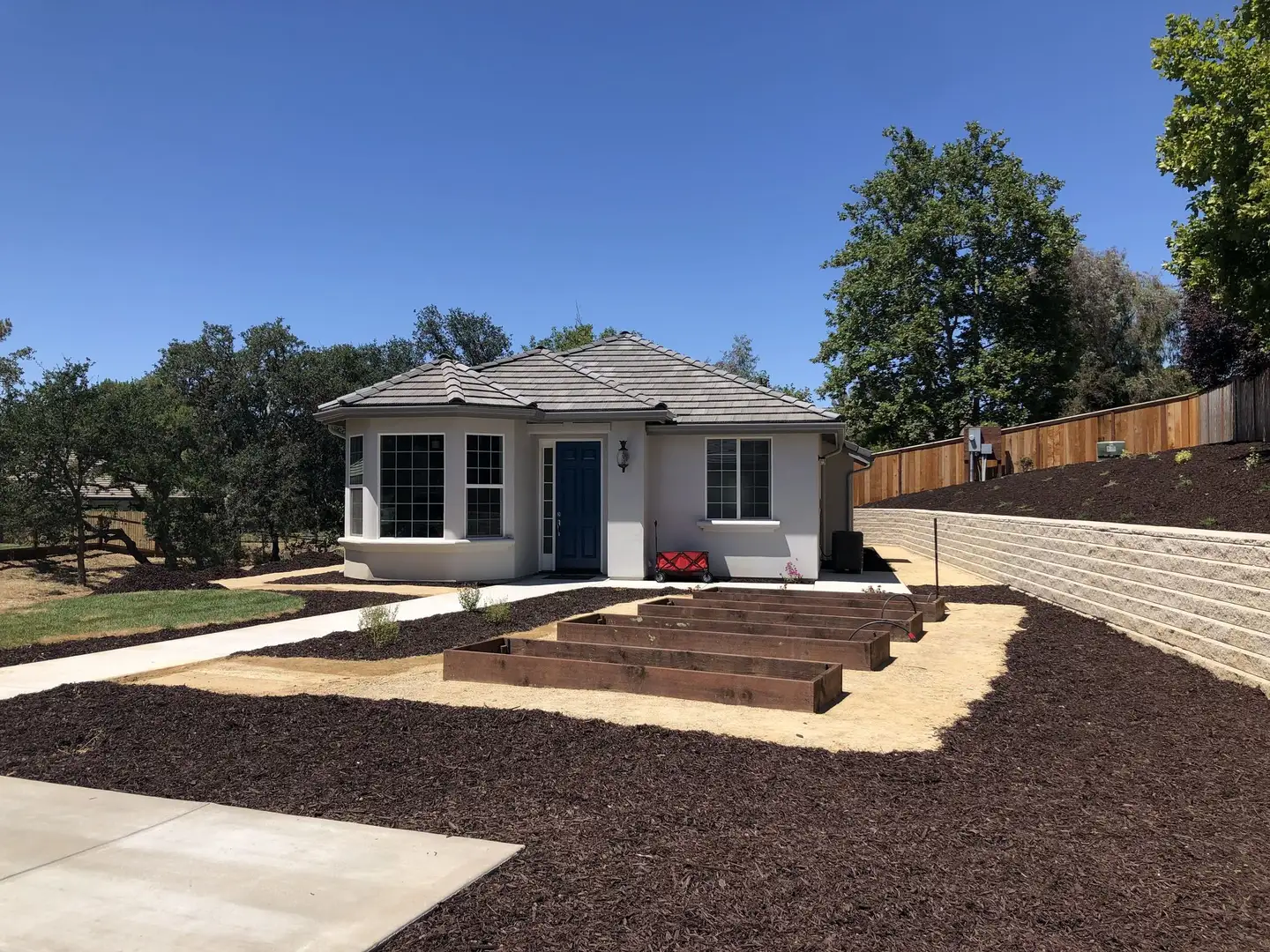
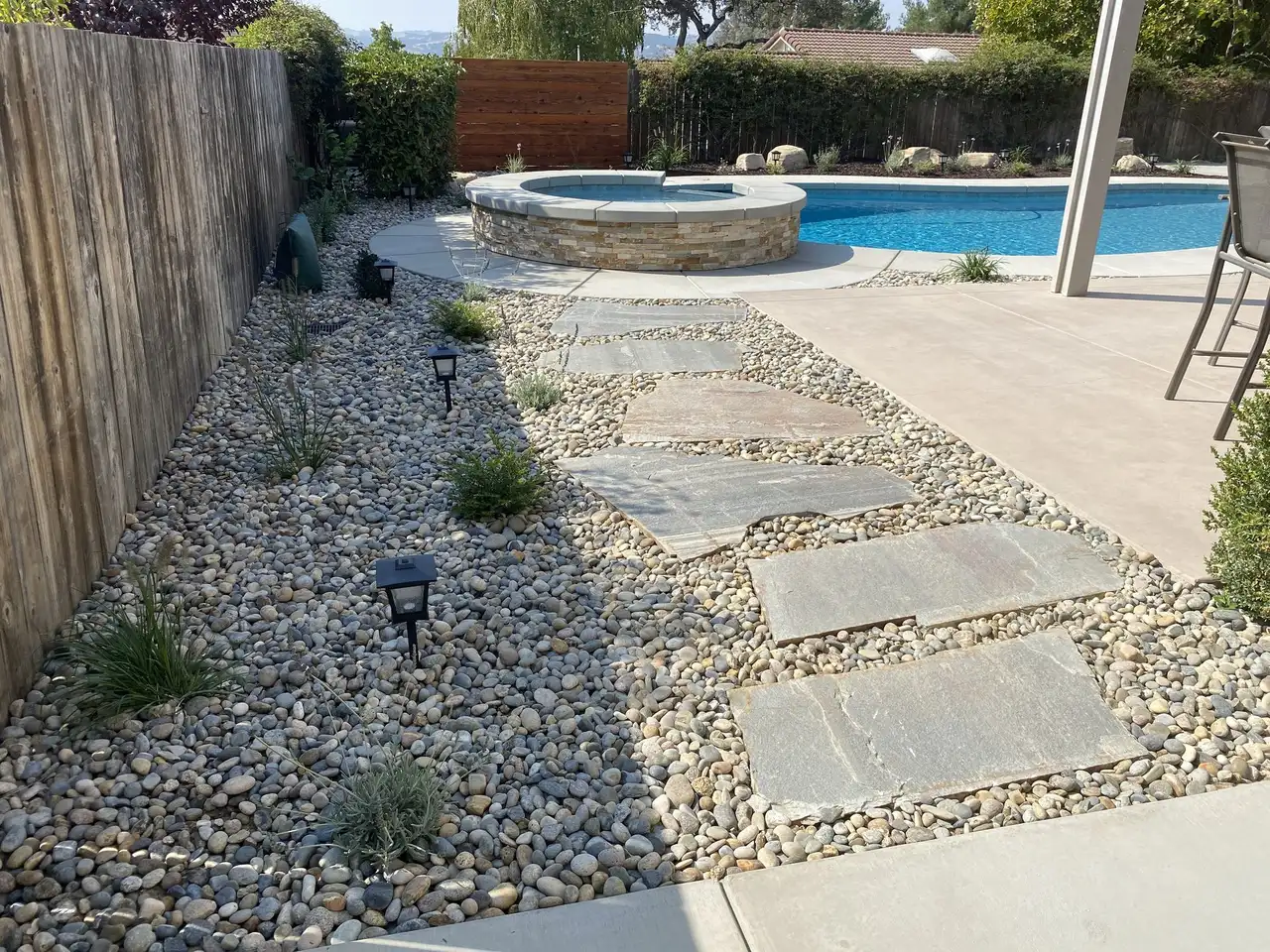
We walk the property with you, map the problem spots and the path water takes, and check for downspouts, slopes and neighbors' lots that send water your way. You get a plan showing new grades, where each downspout goes, swales, drains and any paving changes. The work itself usually means pulling back built-up soil and mulch from the foundation, reshaping grade, trenching and setting pipe, building rock swales or gravel channels, and resetting or replacing paving with a permeable section. We finish by running water through the system with you so you can see where it goes.
We are a landscape contractor, not a civil engineer or a City inspector. Foundation movement, structural cracks or slope failures call for an engineer first; we build the landscape side to their plans and to City requirements.
Drainage Services in Paso Robles
We can handle a single problem area or the whole lot:
- A wet-weather look at the property, noting where water sheets, ponds and leaves the lot
- Regrading beds and lawn edges so soil falls away from the foundation
- Downspout extensions, buried leaders and pop-up emitters that release roof water into planting
- River-rock swales and gravel channels that slow water across the yard
- Permeable pavers and gravel or decomposed granite in place of solid slabs
- Area drains and catch basins with raised inlets, set where the City form calls for them
- Retaining walls with drain rock and weep paths on cut slopes
- Irrigation fixes that stop overspray and runoff onto paving
Keep Reading
Related pages for Paso Robles yards:
- Hardscape in Paso Robles
- Retaining walls in Paso Robles
- Irrigation in Paso Robles
- Fire-safe landscaping in Paso Robles
- Landscape design in Paso Robles
- Templeton
- Atascadero
- Yard drainage in Atascadero
- Yard drainage in Templeton
- Yard drainage in San Luis Obispo
- Concrete patios, walkways and driveways in Paso Robles
- Yard drainage in Arroyo Grande
- Yard drainage in Nipomo
- Yard drainage in Pismo Beach
- Yard drainage in Avila Beach
- Yard drainage in Morro Bay
- Yard drainage in Cayucos
- Yard drainage in Grover Beach
- Yard drainage in Oceano
For the full list of communities, see our San Luis Obispo County service area page.
Frequently Asked Questions
Where should my downspouts drain in Paso Robles?
The City's single-family Stormwater Control Plan form recommends sending roof water to planted areas, either beside the house or piped to beds farther out, with the water spread out so it soaks in. The roof area draining to a bed should be no more than twice the size of that bed.
Do I need a permit for yard drainage work in Paso Robles?
Small jobs often do not, but the City requires a grading permit unless the work fits an exception in Municipal Code 20.04.040. Small fills are exempt only under limits, including not obstructing or diverting a drainage course and disturbing less than 3,000 square feet. Engineering plan check makes the call.
Can rain barrel overflow go into my neighbor's yard?
No. The City's rain barrel guide says overflow must be directed away from building foundations and cannot run onto adjacent properties. It suggests a hose that carries overflow at least 6 feet from the foundation.
Do permeable pavers help with drainage?
They can, if the base is built for it. The City's Technical Guide calls for an open-graded crushed stone base at least 3 inches deep, a rigid edge, and joints of at least 3/8 inch filled with clean aggregate.
Do you handle foundation or slope failures?
We handle the landscape side: grading, swales, downspouts, drains, paving and walls. Cracked foundations or failing slopes need a civil or geotechnical engineer first, and we can build to their plan.
Fix Your Drainage Before the Next Storm
Tell us where water collects on your property, and we will schedule a free walk-through and estimate.
Call 805-712-4440 Get a Free Estimate
Paso Robles Landscaping · 1345 Riverside Ave, Paso Robles · Licensed contractor, CSLB #986950 · Serving all of San Luis Obispo County